
Table of Contents
- Overview
- TheNakedNYC YouTube Highlights
- Design, Construction & Technology
- Capacity, Speed & Passenger Amenities
- Environmental & Economic Impact
- Funding & Government Support
- Hybrid Ferries in the U.S.
- Community & Stakeholder Reactions
- Governors Island Experience
- Wrapping Up
Overview
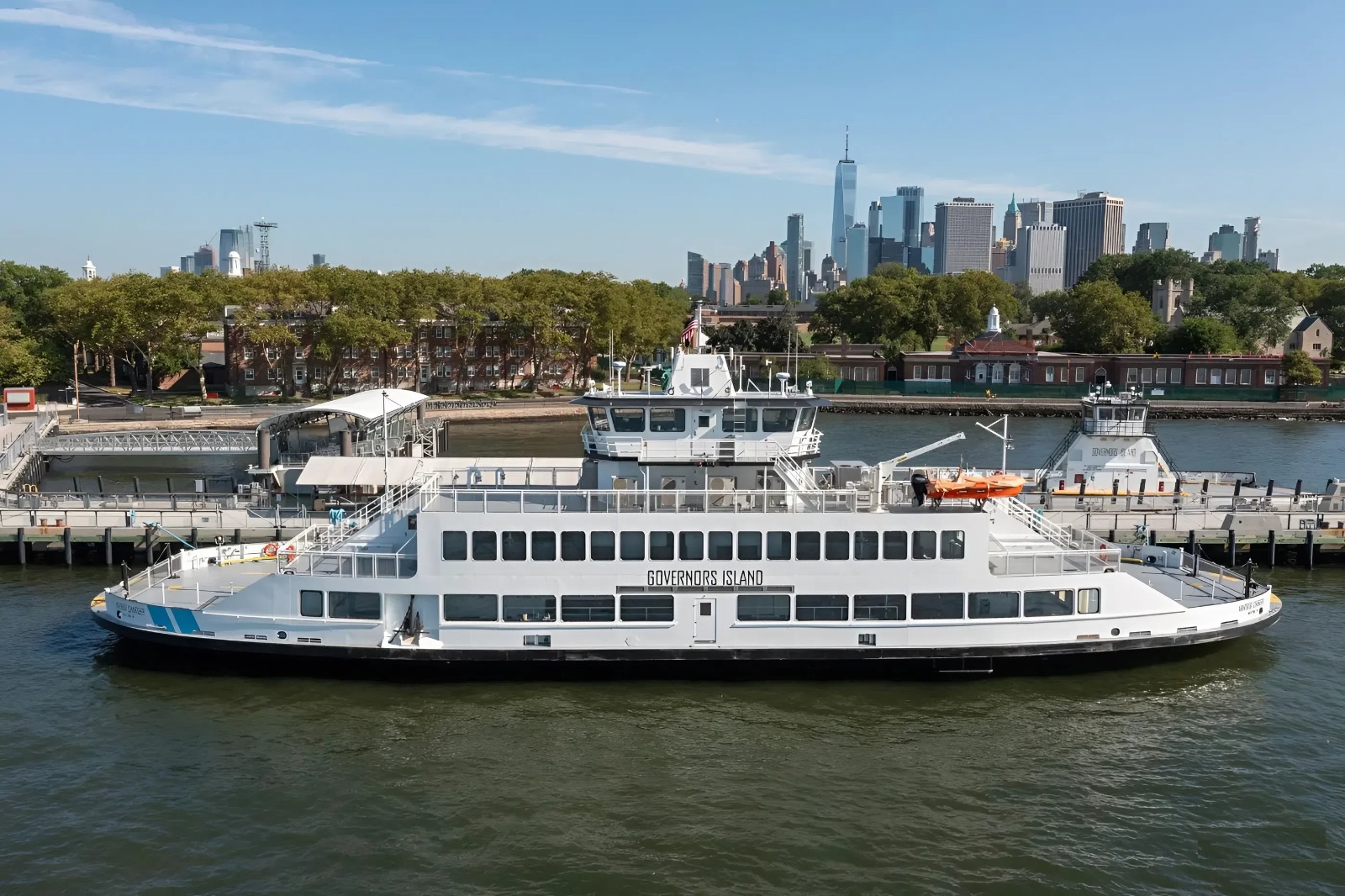
NEW YORK, NY — New York City has launched the Harbor Charger, its first hybrid-electric ferry, marking a milestone in maritime sustainability. The vessel connects Lower Manhattan to Governors Island with faster, quieter, and greener service. Its debut coincides with the island’s 20th anniversary as a public space, reflecting the city’s broader commitment to clean transit. The ferry combines modern engineering with significant environmental benefits, saving fuel costs, reducing emissions, and enhancing passenger comfort. The ship was christened with champagne and named after a citywide competition that drew more than 800 entries. Its introduction symbolizes New York’s commitment to innovation and sustainability. It also strengthens Governors Island’s role as a hub for climate research and public recreation.
For more information, visit govisland.com.
TheNakedNYC YouTube Highlights

Design, Construction & Technology
Built at Conrad Shipyard in Louisiana and designed by Elliott Bay Design Group in Seattle, the Harbor Charger required 465 tons of steel, nearly the weight of eleven subway cars. The ferry incorporates Siemens Energy’s BlueDrive Eco propulsion system, the BlueVault battery solution, and the EcoMAIN monitoring platform.
With 122 lithium-ion batteries, the vessel powers propulsion, lighting, and air conditioning. Schottel azimuthing thrusters enable full 360-degree maneuverability, simplifying docking. The project involved collaboration among Conrad Shipyard, Siemens Energy, Elliott Bay Design Group, and the Trust for Governors Island. It is the second ferry designed by EBDG for the Trust, following Governors 1 in 2019. The Harbor Charger was engineered for a 40- to 60-year service life with sustainability as its core principle.
Capacity, Speed & Passenger Amenities
The ferry accommodates up to 1,200 passengers and 30 vehicles. With a cruising speed of 10 to 12 knots, it operates 66% faster than the island’s current diesel fleet. Passenger amenities include a lower-level ADA-accessible lounge, restrooms on every deck, and air conditioning for seasonal comfort. The vessel can execute 360-degree spin turns, improving docking efficiency. Tickets are priced at five dollars round-trip, with seniors and children traveling free. Passengers also benefit from a quieter, smoother ride compared with diesel-powered ferries.
Environmental & Economic Impact
The Harbor Charger reduces carbon emissions by nearly 600 tons annually. Once shoreside rapid charging is installed, emissions will decline by an additional 800 tons each year. The ferry is projected to save the city more than $200,000 annually in fuel costs. It replaces the aging Lt. Samuel S. Coursen, a diesel ferry commissioned in 1956 that consumed about 420 gallons of fuel daily. By cutting nitrogen oxides and particulates, the Harbor Charger improves public health and air quality. The launch also strengthens Governors Island’s position as a climate research hub, supporting initiatives such as the Billion Oyster Project and the New York Climate Exchange.
Funding & Government Support
The project’s charging infrastructure is funded by a 7.5 million dollar federal grant secured through the efforts of Senators Schumer and Gillibrand and Representative Goldman. Mayor Adams, Governor Hochul, and the NYC Economic Development Corporation praised the vessel as a vital step toward a cleaner transit future. After more than seven years of planning, the Harbor Charger demonstrates New York City’s long-term commitment to sustainability. Despite the rollback of federal clean-transit subsidies, the vessel serves as a proof-of-concept for electrified ferry systems nationwide.
Hybrid Ferries in the U.S.
The Harbor Charger is among the first hybrid-electric ferries in New York and joins a small but expanding U.S. fleet. In July 2025, Washington State Ferries converted the Wenatchee into a hybrid vessel at a cost of 96 million dollars. Siemens Energy has also outfitted ferries in Texas and Louisiana. With ferries ranking among the worst diesel polluters, hybridization has become urgent. Industry observers describe these vessels as the Prius of the seas, highlighting their environmental transformation. Similar innovations include hydrogen-powered ferries in San Francisco and wind-assisted cargo ships.
Community & Stakeholder Reactions
City and state officials praised the Harbor Charger for reducing emissions while improving accessibility. Environmental organizations recognized it as a model for clean maritime transit. Community boards welcomed the quieter service long requested by residents. Academic institutions emphasized its value for climate research and education, while nonprofits and island tenants highlighted its role as a practical sustainability solution. Industry leaders applauded the collaborative innovation that made the project possible. Collectively, stakeholders view the Harbor Charger as a catalyst for green jobs, education, and climate leadership.
Governors Island Experience
Governors Island has welcomed the public for two decades and now attracts nearly one million visitors annually. It offers art installations, nature tours, bike rentals, Hammock Grove, and children’s play areas. Visitors can also camp overnight along the waterfront.
Known as Lower Manhattan’s backyard, the island combines climate research, recreation, and cultural programming. With the Harbor Charger, access has never been easier. The vessel enhances the island’s role as both a sustainable urban retreat and a center for innovation.
Wrapping Up
The Harbor Charger represents more than a transportation upgrade. It demonstrates how New York City can meet climate challenges while improving public amenities.
The vessel proves that sustainable infrastructure can deliver speed, comfort, and resilience without environmental compromise. Its success provides a model for electrified ferry fleets across the nation.
Governors Island now serves as both a recreational escape and a research hub, offering cleaner air and greener opportunities. The Harbor Charger’s arrival cements New York City’s leadership in maritime sustainability.
For more information, visit govisland.com.


Leave a Reply